Labor Shortage and High-Mix Production: Why Your Factory Needs an Andon System
Discover how a modern Andon system can transform your high-mix production by giving your teams the tools to react quickly to problems and increase productivity in a context of labor shortage.
Introduction
The first search result when you ask Google "What is an Andon system" is the theoretical definition of a management system derived from the "Lean Manufacturing" philosophy. "Lean" encompasses Toyota's strategies to optimize factory yields. But concretely? What is it and how can you benefit from it in Quebec's industrial world of high-mix/low-volume production?
More Than Just an Alert Tool
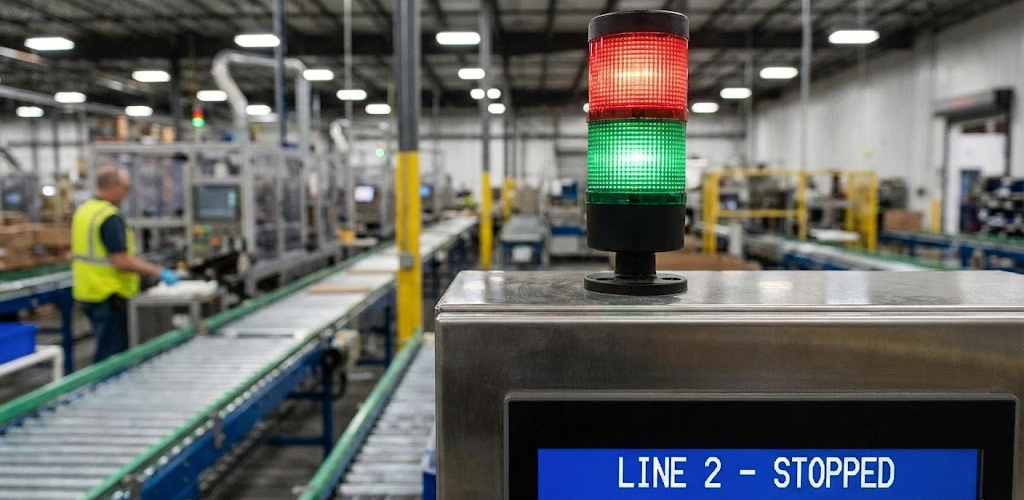
Historically, Andon systems were typically used in their simplest iteration: signaling an ongoing problem on a production line. Think of red or green lights above each workstation. When everything works well, the light is green. When the operator needs assistance, they switch the light to red. In the era of Industry 4.0 and the importance of manufacturing productivity, technological tools offer much more flexibility.
Thanks to touchscreen tablets and automation systems, operators can now capture not only the stoppage but also the reason for the stoppage. The power of automation lies in its ability to instantly redirect alerts to the right people. A stoppage due to "lack of materials" can be configured to send a notification directly to supply chain managers, including the purchase order. This way, each downtime is significantly reduced.
Alerts can be configured with escalation logic. The team leader didn't respond to the operator's alert within the prescribed 5 minutes? The alert escalates to the plant manager and the ticket gets a special status in downtime tracking.
Empower Your Teams to Be More Productive
The manufacturing sector has been stagnating for several years. It's increasingly difficult to hire new employees and the productivity gap is widening with other Canadian provinces and the United States.
According to a STIQ study, 70% of manufacturing companies are currently facing a succession crisis. Employees are retiring and replacements are scarce. Factory veterans leave with their knowledge and years of experience on the machinery. It's therefore even more important to implement tools like an Andon system to facilitate the integration of new employees and quickly increase work team productivity.
The Andon system should not be presented as a surveillance tool, but as an operator's assistant. We reverse the responsibility: instead of calculating downtime, we calculate the response time of the person responsible for the alert.
A Management Tool
In mass production, the Andon system serves to optimize a repetitive process. In a manufacturing landscape like Quebec's, you must deal with the reality of high-mix production and numerous changeovers (setups). The Andon system primarily allows for quick assistance requests during these transitions.
An Andon system integrated into Industry 4.0 is very powerful for decision-making. Indeed, when connected to the production monitoring system and real-time KPI calculation, you can quickly change processes and see the results. The relevance of an Andon system that records alert history is that you can quickly identify the source of frequent stoppages.
For example, if at the end of the month the system highlights that 80% of stoppages come from a material shortage at station 3, you make process changes and quickly observe the subsequent results.
The impact of having real-time visibility is immediately beneficial for administration, but also for teams. Knowing what's happening without having to run around everywhere reassures managers and also motivates teams to stay on track.
Conclusion
Is your factory ready to improve its response times and support its operators? Don't let small stoppages become big problems. Let's discuss how an Andon system can be easily installed in your production environment.